GEO vs SEO: Key Differences and How to Win at Both
GEO isn't replacing SEO — but it is reshaping it. These are two distinct disciplines that serve different discovery surfaces, reward different content characteristics, and require different measurement approaches. Understanding where they diverge and where they reinforce each other is the key to building an organic strategy that works everywhere your buyers search.
The fundamental difference
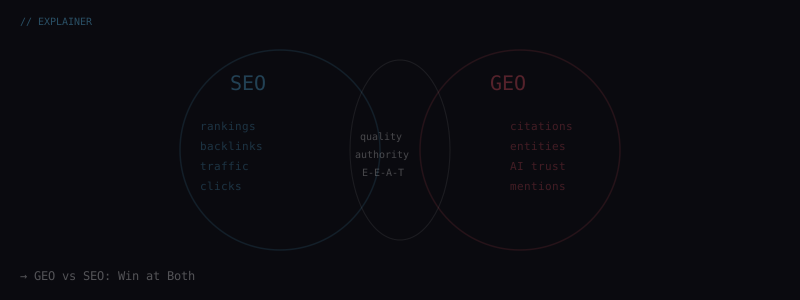
SEO is about earning a position on a results page. You optimize a page, it ranks, and users click through to your site. The unit of measurement is the ranking, and the goal is the click.
GEO is about earning a citation in a generated answer. You build authority across your digital footprint, and AI models select you as a trusted source when constructing a response. The unit of measurement is the citation, and the goal is brand inclusion in the answer itself.
This distinction matters because the strategies that win in each channel, while overlapping, have meaningful differences in emphasis and execution.
Where SEO and GEO diverge
Content format
SEO rewards comprehensive, long-form content that covers a topic exhaustively — Google likes pages that fully satisfy search intent. GEO rewards content with clear, citable claims and structured information that models can extract and reference. The best GEO content makes specific, defensible assertions backed by evidence — not sprawling 5,000-word guides that bury the key insight in paragraph 47.
Authority signals
SEO authority is primarily measured through backlinks — the quantity and quality of other sites linking to you. GEO authority is measured through entity recognition — how well-known your brand is across knowledge graphs, databases, and the broader web. Backlinks still matter for GEO (they correlate with authority), but entity presence matters more.
Measurement
SEO measurement is mature: rankings, organic traffic, click-through rates, conversions. GEO measurement is emerging: citation frequency, competitive citation share, AI referral traffic, and brand search lift. If you're only tracking SEO metrics, you're blind to GEO performance.
Competition model
In SEO, you compete for 10 blue links. In GEO, you compete for inclusion in a single synthesized answer that may recommend 2-4 brands. The competitive dynamics are more winner-take-all in GEO — there's no "page 2" in a ChatGPT response.
Where SEO and GEO reinforce each other
Content quality
Both channels reward expertise, accuracy, and trustworthiness. Content built from genuine subject matter expertise — not keyword-stuffed filler — performs well in traditional search and gets cited by AI. This is the biggest overlap and the foundation of any unified strategy.
Technical foundation
Clean site architecture, fast load times, proper schema markup, and structured content all benefit both SEO rankings and GEO citation probability. The technical foundation you build for SEO directly supports GEO performance.
Topical authority
When you build comprehensive coverage of a topic through interlinked content (pillar pages, supporting articles, FAQ content), you're simultaneously building SEO topical authority and GEO entity authority. Search engines and AI models both recognize deep, consistent expertise on a subject.
Brand authority
Strong brands rank better in SEO (brand signals are a confirmed ranking factor) and get cited more often in GEO (models preferentially cite recognizable, trusted brands). Everything you do to build brand awareness helps both channels.
Building a unified strategy
The smartest approach isn't "SEO or GEO" — it's building a strategy where every content investment serves both channels. Here's how:
- Start with SEO fundamentals — technical health, keyword strategy, content quality. These are the foundation for everything
- Layer GEO-specific optimizations onto your content: clearer claims, better structured data, citation-friendly formatting
- Invest in entity authority: PR, industry directories, speaking engagements, and knowledge graph presence
- Build measurement for both: traditional SEO dashboards plus GEO citation tracking and AI referral analytics
- Allocate content resources with both channels in mind: every major piece should be optimized for ranking and citation
The timeline: SEO is the engine, GEO is the amplifier
SEO delivers measurable results in 3-6 months. GEO compounds more slowly — citation patterns shift over months as models update and your authority signals strengthen. Think of SEO as the engine that drives near-term pipeline and GEO as the amplifier that expands your reach into entirely new discovery surfaces over time.
Companies that start both now — with SEO as the priority and GEO as the accelerant — will be the ones whose signal is loudest 12-24 months from today.
The question isn't GEO or SEO. It's whether you're building for the search landscape of 2024 or the one that's already here in 2026. The answer is both — unified, compounding, and getting stronger every month.
Ready for a strategy that wins on every surface?
We build integrated SEO + GEO systems for B2B brands that need to be found everywhere their buyers search — in Google, in AI, and everywhere in between.
Send a Signal →